Wednesday, February 29, 2012

Does Anyone See This Emergency As An Emergency, Or Is A Half Trillion Euro Pay Day Loan Bullish?


Does Anyone See This Emergency As An Emergency, Or Is A Half Trillion Euro Pay Day Loan Bullish?


Reggie Middleton's picture


Euro-area banks tapped the European Central Bank for a record amount of three-year cash in an operation that may boost bond and equity markets.
The Frankfurt-based ECB said today it will lend 800 financial institutions 529.5 billion euros ($712.2 billion) for 1,092 days. Economists predicted an allotment of 470 billion euros, according to the median of 28 estimates in a Bloomberg News survey. In the ECB’s first three-year operation in December, 523 banks borrowed 489 billion euros.
So, basically, nearly twice as many banks are in trouble now as compared to just three months ago. This is bullish, right???!!!
“The astonishing number this time is the number of banks participating, which signals that a lot more small banks looked for the money and it is likely they will pass it on to the economy,” said Laurent Fransolet, head of fixed income strategy Barclays Capital in London, who estimates about 300 billion euros of the total is new lending. “So the impact may be bigger than with the first one.”
I'm not familiar with the quality and/or strength of the shit they smoke over there in London, but from the looks of things it appears to be potent enough. Let's take this bloke's comment to heart, "it is likely they will pass it on to the economy,” . Okay, now where do I begin? Exactly how much of first LTRO made it into the actual economy versus being hoarded by the banks? Is the "pass[ing] it on the the economy" the reason why there is now so much liquidity in European CRE? Here's a quick reminder of where I stand on this...
So, it's safe to say that all of those European REITs and real estate concerns with property mortgages coming up for renewal while underwater will definitively see most of that LTRO 2 money, right? Let's all take a deep breath and hold it as we wait for that one to happen. Ready? One... Two... Three... What do you think, pray tell, happens when the liquidity starved, capital deprived, over leveraged banks fail to roll over all of that underwater Eu mortgage debt?
Slide21Slide21Slide21Slide21
Investors seeking safety in Germany, the UK and France may truly be in for a rude awakening!
Slide22

Reggie Middleton Featured in Property EU, one of Europes leading real estate publicatios

Those who wish to download the full article in PDF format can do so here: Reggie Middleton on Stagflation, Sovereign Debt and the Potential for bank Failure at the ING ACADEMY-v2.

'Nuff said! Subscribers, as (not if, but as) this breaks, these are
the companies trading at the valuations that are most
shortable/profitable in my opinion...

US CRE

European Insurance

European CRE (this one is a bit dated)

European banking

And the cat that was already let out of the bag...

Change we can believe in???---Only 54% Of Young Adults In America Have A Job


Only 54% Of Young Adults In America Have A Job

 
Submitted by Tyler Durden on 02/29/2012 23:32 -0500


A month ago, Zero Hedge readers were stunned to learn that unemployment among Europe's young adults has exploded as a result of the European financial crisis, and peaking anywhere between 46% in the case of Greece all they way to 51% for Spain. Which makes us wonder what the reaction will be to the discovery that when it comes to young adults (18-24) in the US, the employment rate is just barely above half, or 54%, which just happens to be the lowest in 64 years, and 7% worse than when Obama took office promising a whole lot of change 3 years ago.
And while technically this means 46% are unemployed, or the same percentage as in Greece, the US ratio, which comes from Pew, shows the ratio as a % of the total population: a very sensitive topic now that every month we see another 250,000 drop off mysteriously from the total labor force. However, unlike those on the trailing age end, young adults by definition are the labor force in their age group demographic, so it would be difficult to explain away this horrendous number by claiming that ever more 24 year olds are retiring. Although, yes, we agree that some may be dropping out of the labor force in order to go to college, incidentally the locus of the latest credit bubble, where they meet a fate worse even than secular unemployment: they become debt slaves of the Federal System, with non-dischargable debt at that, which even assuming they can get a job would take ages to pay back!
But wait: there's more - of all age groups, this is the one that has actually seen its wages drop the most under the Obama administration.
So not only are they unemployed, young adults are at least poor.
Net result: double the change, zero the hope.


Love this dude's Logic....A Black Republican's Thoughts on Obama


Love this dude's Logic....A Black Republican's Thoughts on

Obama


Still funny and appropriate...Tea Party Patriots Invite Janeane Garofalo for America's Tea Party on July 4, 2009!


Still funny and appropriate...Tea Party Patriots Invite Janeane Garofalo

 for America's Tea Party on July 4, 2009!


Savage has a point... Michael Savage: Santorum is a Lunatic!


Savage has a point... Michael Savage: Santorum is a Lunatic!


Why can't any of our candidates have a real plan that they can actually explain to fix this country???


What is Gold worth according to the Buffet Man ???

What is Gold worth according to the Buffet Man ???

In Warren Buffett’s latest round of gold-bashing last weekend, he described all the gold in the world as a useless cube that would fit snugly within a baseball infield.If you owned such a cube, you would only be able to ‘fondle’ it… but generate no investment return.  The same ‘value’, meanwhile, would allow the owner to purchase all the productive farmland in the United States plus 16 Exxon Mobils, in total yielding over $800 billion annually.Granted, Buffett’s views on gold are perhaps stymied by his poor experience investing in silver some 15-years ago. But still, he fails to see some obvious fallacies in his logic.
Most assets left unmanaged will fail to produce an investment return. The virtuous farmland that Buffett extols in his hypothetical example does not magically spawn corn, nurture it, harvest it, sell it, and deposit the proceeds into its owners’ pockets. Our farmland here in Chile certainly does not.
No, it takes a lot of work, a lot of experienced people, a lot of know-how, and a little bit of luck. All of this has to be managed.
Even the baseball field that Buffett references (when trying to give his investors an idea of the scale of all the gold in the world) is an asset. Simply left sitting there, a baseball field will soon be overtaken by erosion, weeds, and the dilapidation that comes with neglect.
Maintained and well-managed, however, a savvy owner of a baseball field can lease it out to the local little league. Or pull a Kevin Costner and turn it into a tourist attraction. None of this happens without appropriately managing the asset.
Even Exxon Mobil, with all of its royalties and intellectual property, requires tens of thousands of employees to manage the company’s assets, collect the profits, and ensure shareholders get paid.
Likewise, a huge cube of gold left alone in a baseball infield will fail to produce any investment return. When managed, however, gold is like any other asset– it can be leased, traded, loaned out, used as collateral, etc.
More importantly, though, the reason that many gold investors purchase the metal to begin with is because physical gold carries no counterparty risk.
Unlike paper currencies which are issued at will by corrupt central banks, or even Exxon Mobil, whose success depends heavily on the management team’s goodwill and diligence, a one ounce gold coin in your pocket will still be a one ounce gold coin tomorrow. This is the entire premise behind money as a store of value.
As my friend Tim Price told me over drinks in London several months ago, fiat currency is simply an abstraction of the concept of money; paper money conjured out of thin air cannot be real money, it’s merely an idea based on confidence and collusion.
Curiously, only a tiny percentage of worldwide money supply is actually physical paper– most ‘money’ is in digital form, simply entries in a computer… a few bits of code which constitute your net worth. In this way, our currency is actually an abstraction of an abstraction of the concept of money.
To this I would add that the entire financial system is underpinned by a complex network of hypothecated debt and derivative instruments whose notional total exceeds (by many multiples) the entirety of world GDP. In this manner, we are talking about abstractions of abstractions of abstractions.
Gold is real. It exists. And it scarcity dictates that it is a reasonable store of value, particularly in a world of abstract money.
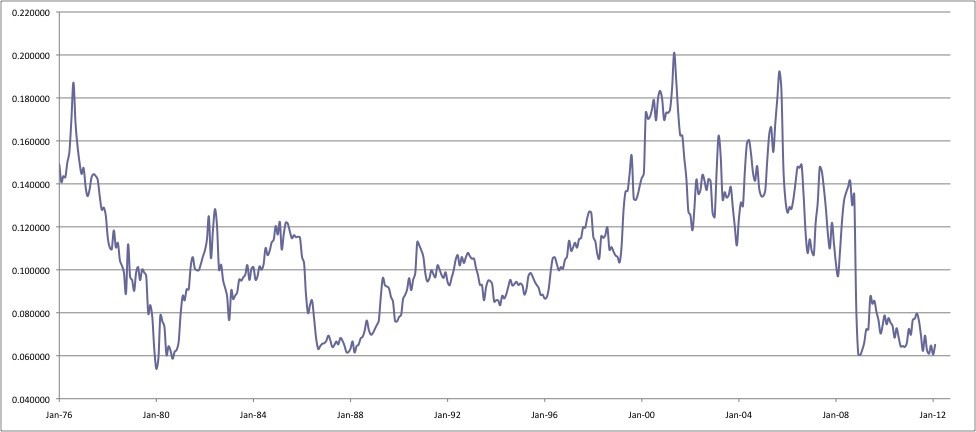
There’s a lot of talk right now, for example, about rising oil prices which have created uncomfortably high gasoline prices. In gold terms, however, gasoline prices are in a deflationary spiral. The chart below shows unleaded gasoline prices in grams of gold since January 1976:
20120301 36year gas v gold 300x132 About those high gasoline prices...look again
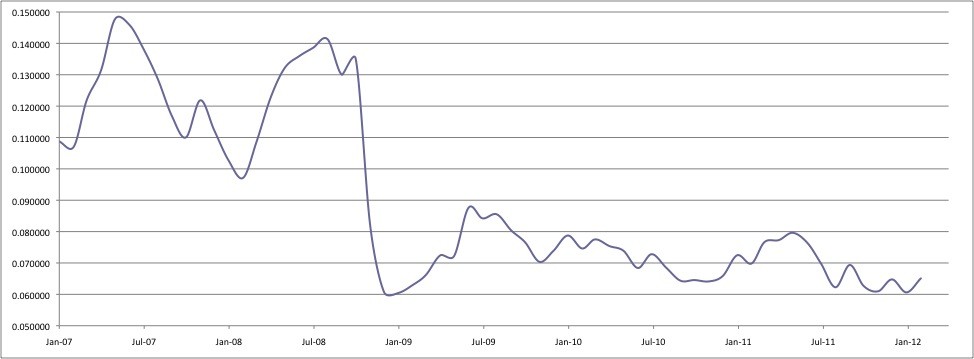
and for the last five years:
20120301 5year gas v gold 300x110 About those high gasoline prices...look again
Priced in grams of gold, gasoline is near an all-time low. [In fact, there's a great siterun by my friend Charles V. that shows this trend with a variety of commodities and retail goods.]Buffett (and others) argue strongly that investors should be in stocks… that a company like Coca Cola or productive farmland is a better long-term investment than a useless hunk of metal.He’s probably right. Except that the useless hunk of metal isn’t really an investment. It’s an anti-currency… appropriate for those who want to sit out of the market and be in cash without having to be in cash.

Tuesday, February 28, 2012

I, Putin' An Inside Look at Russia's Aging, Lonely Leader


Some of this interview reminds me of how the Press (liberals) treated Ronald Reagan..


I, Putin'

An Inside Look at Russia's Aging, Lonely Leader


Photo Gallery: A Behind-the-Scenes Look at Putin
Photos
NDR/ cinecentrum
The world is used to macho images of Vladimir Putin hunting bears, harpooning whales or fly-fishing. A German documentary filmmaker was recently granted unprecedented access to the Russian prime minister. And he found a lonely, aging and surprisingly likeable man.

read the rest of article here..http://www.spiegel.de/international/world/0,1518,817138,00.html


Surprisingly Likeable
Putin pretends to be open-minded, knowing that he can't treat a German television reporter the same way. But in some interviews with Seipel, he clearly seems annoyed by the never-ending questions about the West's criticism of his policies, saying curtly: "We already talked about that."
Putin ensnared the filmmaker in his own way. Though never chummy, he did indicate that he liked Seipel, sometimes spontaneously inviting him to spend several hours with him over dinner, though without the cameras. "Politically speaking, he's light-years away from me," Seipel says. "It also took me a while to gradually understand what makes him tick. Still, I can't say that I disliked him as a human being."


On one occasion, Putin has his convoy stop somewhere outside Moscow and waved to Seipel and his cameraman to get out of their car and follow him. He said he wanted to show them something special and led them along a narrow path to his private chapel, where he told them about his faith and how his mother had secretly had him baptized. The temptation to focus on these images of a very private Putin must have been tremendous. But Seipel felt that the scene was too private, so he simply left it out of his film.
Why did Seipel leave this out of his film???

S&P Declares Greece in Default


Greece became the first euro-zone member officially to be rated in default, 13 years after the single European currency was adopted to strengthen the European Union.
Standard & Poor's cut Greece's long-term credit rating to selective default from double-C. The move was expected, as S&P said this month that it would consider Greece in default if it added "collective-action" clauses to its sovereign debt, effectively forcing all bondholders to accept a bond-swap offering. ...

Greek,Government Disfunctionation----Note from Athens:


rest of article here..

http://economistmeg.com/2012/02/27/note-from-athens-feeling-on-the-ground-has-palpably-changed/


Note from Athens: Feeling on the ground has palpably changed

 
Doing Business in Greece: An Uphill Battle
 
While the political elite and public in Greece remain dedicated—for now—to the common currency, it is difficult to see how Greece will manage to restructure its economy and return to growth before either the troika or the Greeks themselves run out of patience. A number of contacts described their experiences trying to open a business or buy property, which involved high fees, several trips to different tax offices and months of navigating bureaucracy. This gets at the very heart of how Greece landed up in its current condition and why rapid change is unlikely. Entire professions such as notaries, lawyers, tax men, architects and inspectors have for years had automatic income in that they have formed the layers of bureaucracy involved in doing business in Greece. At least half of the MPs in Greek parliament hail from these industries, and consequently are incentivized to perpetuate the bureaucracy that impedes opening up, running or finding investment for businesses.
This is best encapsulated in an anecdote from my visit to Athens. A friend and I met up at a new bookstore and café in the centre of town, which has only been open for a month. The establishment is in the center of an area filled with bars, and the owner decided the neighborhood could use a place for people to convene and talk without having to drink alcohol and listen to loud music. After we sat down, we asked the waitress for a coffee. She thanked us for our order and immediately turned and walked out the front door. My friend explained that the owner of the bookstore/café couldn’t get a license to provide coffee. She had tried to just buy a coffee machine and give the coffee away for free, thinking that lingering patrons would boost book sales.  However, giving away coffee was illegal as well. Instead, the owner had to strike a deal with a bar across the street, whereby they make the coffee and the waitress spends all day shuttling between the bar and the bookstore/café. My friend also explained to me that books could not be purchased at the bookstore, as it was after 18h and it is illegal to sell books in Greece beyond that hour. I was in a bookstore/café that could neither sell books nor make coffee. (Emphasis mine)
Legislation in Greece has been set up on an ad hoc basis, with laws just layered over—and often contradicting—one another. No one has taken a holistic view of the system and consolidated it. Furthermore, if an investor were to need to turn to Greek courts, the case would not be heard for years. If the investor were foreign, the chances of a ruling in their favor would be extremely slim. It is hard to see how investment will return to Greece unless these issues are addressed, but the government is incentivized to obstruct progress in doing so. There is a lot of discussion among analysts of a Marshall Plan for Greece, but it is difficult to see German companies tolerating such an operating environment.
For a more in depth account of what I learned in Athens, please see RGE’s On Life Support, For Now: A Greek Trip Report

BUSINESS ‘BUY A GUN’ & ‘KEEP YOUR POWDER DRY’: ECONOMISTS WARN OF LOOMING ‘ECONOMIC 9/11′


BUSINESS‘BUY A GUN’ & ‘KEEP YOUR POWDER DRY’: ECONOMISTS WARN OF LOOMING ‘ECONOMIC 9/11′


Buy a Gun & Keep Your Powder Dry: Economists Warn of Looming Economic 9/11Left to Right: Harry Dent, Robert Prechte, & Gerald Celente
Despite recent reports that the U.S. economy is “recovering” and that there are signs of economic growth, some analysts are less than thrilled with what they see in the near future. In fact, they’re downright scared.
Harry Dent, author of “The Great Crash Ahead,” believes that the global debt bubble is going to burst and when it does, there will be a massive market crash. It should be noted that this is a revision of his earlier prediction that a crash would hit in 2012. He says he modified his forecast because the global central banks have been pumping the markets with so much money, stocks have been given a temporary boost. But he warns that as soon as the short-lived boost comes to an end, the crash will be hard.
“This will be a repeat of 2008-09, only bigger, when it finally hits,” Dent told USA Today.
Watch a discussion of this topic from Monday night’s broadcast of “Real News From The Blaze” by clicking here.
Gerald Celente, a market analyst at the Trends Research Institute, believes Americans should brace themselves for what he calls an “economic 9/11.” He blames policymakers for their inability to solve the world’s financial and economic woes, according to the USA Today report.
Once the meltdown hits, he says, it will lead to social upheaval, anti-government sentiment, a devalued U.S. dollar, and skyrocketing unemployment.
“Celente won‘t rule out another financial panic that could spark enough fear to cause a run on the nation’s banks by depositors,” USA Today reports. “That risk could cause the government to invoke ‘economic martial law’ and call a ‘bank holiday’ and close banks as it did during the Great Depression.”
Click here to find out more!
“We see some kind of threat of that magnitude,” Celente said in a recent interview.
Robert Prechter, author of “Conquer the Crash,” is being described as “still bearish.” Because he believes there is a frightening amount of similarities between today’s economy and the one preceding the Great Depression, he warns that America should brace for “1930s-style deflation.”
Buy a Gun & Keep Your Powder Dry: Economists Warn of Looming Economic 9/11“Prechter predicts that the major U.S. stock indexes, such as the Dow Jones industrials and Standard & Poor’s 500, will plunge below their bear market lows hit in March 2009 during the last financial crisis,” USA Today reports. “The brief recovery will fail as it did in the 1930s, he says.”
What does this mean? Well, if Prechter is correct, stocks stand to lose more than half of their value.
“The economic recovery has been weak, so the next downturn should generate bad news in a big way,” Prechter said in an e-mail interview. “For the third time in a dozen years, the stock market is in a very bearish position.”
But what about all that “positive” economic news we keep hearing about?
Take, for example, recent reports that the markets are rebounding. Many economists have noted that the markets are finally approaching pre-2008 levels.
“Tech stocks in the Nasdaq composite are trading at levels last seen in 2000. Data on auto sales, manufacturing and consumer confidence have been firming. Job creation is also on the rise. The unemployment rate dipped to 8.3% in January, its lowest level in three years,” USA Today argues.
Buy a Gun & Keep Your Powder Dry: Economists Warn of Looming Economic 9/11Furthermore, economists and market analysts are updating their forecasts and predicting a hopeful and bright economic future. Some have even bet that the eurozone will stabilize.
So why are Prechter, Celente, and Dent so worried?
“Dent says the combination of aging Baby Boomers exiting their big spending years and a shift toward debt reduction and austerity around the world will cause the economy to suffer another severe leg down, making it more difficult for the government and Federal Reserve to avert a new meltdown,” USA Today reports.
Celente, on the other hand, who has also been warning of economic disaster for years, believes that the national debts and “income inequality” has put the U.S. in a very dangerous place.
He warns that bank runs, brought about by social unrest, will wreak sever economic havoc. He also warns that the current economic crisis could very easily transform into real violence. He believes the markets will be turned upside down by not only the eurozone crisis but also by an increase in oil prices due to the standoff between Iran and the West.
“2012 is when many of the long-simmering socioeconomic and political trends that we have been forecasting and tracking will climax,” Celente wrote in his “Top 12 Trends 2012” newsletter.
“When money stops flowing to the man on the street, blood starts flowing in the street,” he added in an interview.
So, although some are economists are advising investors to jump back into the markets, these three analysts are warning that a different strategy is needed.
Buy a Gun & Keep Your Powder Dry: Economists Warn of Looming Economic 9/11“Get out of the way,” Dent advises.
His solution? Buy short-term U.S. Treasury bills and the U.S. dollar, which will benefit from safe-haven cash flows. Forget stocks; they’ll fall in value.
Celente advises investors to buy gold – it won’t lose its purchasing power when the dollar tanks. Also, he says, buy a gun to protect yourself from marauders in search of food and money. He also advises people to plan a getaway to places with “more stable finances and governments.”
Prechter’s advice? Simple: keep your powder dry and buy when the economy starts to get out of hand.
“When things get really scary, as in early 2009, I get bullish,” he said.