Saturday, December 31, 2011

Making Sense Of 2011--THE DAILY CAPITALIST..


THE DAILY CAPITALIST...


Making Sense Of 2011


Here is what really interests me about 2011: Looking back in time since the Crash of ’08, I am impressed by how closely our depression has hewn to classic depression models, especially the Great Depression of the 30s and 40s where there was so much government meddling in the economy. (I urge anyone to read Murray Rothbard’s America’s Great Depression for the best analysis.) For example, we continue to experience the following indicia of a depression:
The classic credit crunch/liquidity freeze. It was “solved” but only for Wall Street and the big corporations. Not much has trickled down to the masses. The Fed opened the money sluices in 2009 and stood as a lender of last resort to the commercial paper market and opened up the discount window to all comers (not only the Primary Dealers, but also the money market funds and others). But the LRBs (local and regional banks) are something else. Their loan books are still lean (they are looking to new,riskier investments to pump up earnings). What is interesting is not that there is a lack of money for lenders to lend, but loan demand is weak. If you read the reports from the National Federation of Independent Businesses, small businesses (<500 employees) aren’t borrowing. They aren’t willing to take on debt because of uncertainty about the future of the economy and the future of government policies.
High level of unemployment. This has been persistent and is not yielding to classic Keynesian fiscal stimulus nostrums—not that they have ever worked. The reasons for this are complex, but it has mostly to do with capital destruction. And that has to do with the concept of deleveraging/liquidation of malinvested projects. I believe we still have a long way to go before we can say that there will be enough real capital formed to restart the economy and create jobs. Real capital is not something that can be printed; it must be earned and saved. Let me put it another way: if there were sufficient real capital, we would be in recovery and unemployment would be much lower.
Declining prices. We have been having “inflation” in the Austrian economic theory sense (money supply expansion), but official price inflation measures have been modest and are now declining. If you look at the charts on True (Austrian) Money Supply, we have seen money supply expansion for most of this year and it has resulted in what most economists interpret as economic growth. What they are seeing for the most part is money steroids-induced growth. When the money goes away, the activity goes away.
Deleveraging/Liquidation of Malinvestment. We see persistent declining prices in major asset classes (real estate) because of the continuing deleveraging/liquidation of malinvestments. This is most obvious in the housing markets where prices continue to decline. There is also another factor and that is the oncoming worldwide economic recession has reduced demand for commodities and those prices are declining (See the PPI). To complicate matters, the current economic good news is a head fake, mostly an artifact of an increasing money supply. The effect of monetary stimulation is wearing off and economic activity is starting to decline (almost all measures of manufacturing and industrial activity in the U.S. are declining, but that is another article, soon). 
Contracting money supply (deflation). Money supply may be contracting again. I believe this will result in further economic stagnation, a decline in the stock markets, an acceleration of declining prices and wages, and more quantitative easing. I am not suggesting that QE creates positive economic effects, but after the current money supply expansion wears off (the above noted head fake), a decline in money supply will indicate reduced economic activity. The government and the Fed, as well as the central banks of the major economies, will fight this with every tool they have.
Failed fiscal stimulus. We don’t need to say much anymore about this as we see our president on the stump in a rather desperate attempt to pump us up in the hope that talking about the subject will create jobs. Conventional wisdom still beats this drum in favor of more spending and more debt. But that won’t fly with the Republicans, at least before the election. 
A resurgence of gold as an investment asset. Massive government debt and Fed money supply expansion has created an unstable future, a weak dollar, and a demand for gold and silver. We have seen major banks and hedge funds jump on the gold train, something that they never have considered before. As DoctoRx has written many timesgold and silver have been overhyped, but still remains an important investment in view of long-term economic risks. As readers know, he suggests waiting on the sidelines for a while longer. Much of gold’s price depends on the status of the dollar, U.S. economic performance, U.S. debt levels, Fed policies, general commodities prices, and  instability in the rest of the world. Unlike FDR, citizens have the right to own gold and protect themselves against long-term degradation of their assets.
In other words, no matter how much the Fed and the Administration try to flog the economy, nothing has really worked. As much as Bernanke boasted about being able to prevent another depression, he and the Bush-Obama Administrations have done everything they could to make things worse. And the classic indicators of a depression are still playing out and reminding us of the inefficacy and incompetence of conventional economic wisdom.
What will 2012 bring? I don’t exactly know, but I think it will be continued economic stagnation and perhaps even negative GDP, continued high unemployment, and more quantitative easing. (I will discuss this soon.) What will really be important in 2012 is the Presidential and Congressional elections. If the Republicans take hold of the presidency and Congress, then in 2013 we can hope Obamacare will be repealed, spending will be seriously cut, and some of the more egregious new regulations will be eliminated. I don’t have a lot of faith in the Republicans to achieve real reform, but I think they will know why they were voted in and that they will have only 3 years to attack some of our fundamental problems (spending, debt, entitlements). If Obamacare manages to take hold, then I don’t have much hope for America’s long-term prospects.

Friday, December 30, 2011

GOVERNMENT MOTORS ( GM) FORGOT TO PUT THE BRAKES ON 4000 CARS IT SHIPPED....??

GOVERNMENT MOTORS ( GM) FORGOT TO PUT THE BRAKES ON 4000 CARS IT SHIPPED....??


GM Sonic Recall

GM recalling Chevrolet Sonics to check brake pads

Published: Friday, Dec. 30, 2011 - 7:56 am
Last Modified: Friday, Dec. 30, 2011 - 10:19 am
General Motors Co. said on Friday that it is recalling more than 4,000 of its 2012 Chevrolet Sonic subcompact cars to check for missing brake pads.
The possibility that some Sonics could be missing an inner or outer brake pad was discovered during warranty service for a rental vehicle customer. GM said the problem "is expected to exist in very few cars," and there are no known crashes or injuries related to the issue. A missing pad could require longer stopping distance, and contribute to a crash.
The recall involves 4,296 of GM's 2012 Sonics sold in the U.S. The affected models are from the Orion Township, Mich., assembly plant, where the Sonic is built for sale in the U.S. and Canada.
Dealers will inspect the front brakes for missing inner or outer pads and, if a pad is missing, install new pads. If needed, a new brake caliper or brake rotor, or both, will also be installed. Affected customers will receive dealer letters beginning Jan. 14.

Thursday, December 29, 2011

PHILLY COUNCILWOMAN WILL ‘RETIRE’ FOR ONE DAY, COLLECT A $478K PENSION, AND RETURN ON MONDAY


PHILLY COUNCILWOMAN WILL ‘RETIRE’ FOR ONE DAY, COLLECT A $478K PENSION, AND RETURN ON MONDAY  

Philadelphia is known as the city of brotherly love and, apparently, paying out massive pensions to public employees who will continue working for the city.
Marion B. Tasco, who has been described as being “politically savvy,” will retire from her sixth term as councilwoman, collect $478,057, and then be sworn in on Monday to serve her seventh term, Catherine Lucy and Chris Brennan of the Philadelphia Daily News.
How does she get away with this?
Tasco, along with many of her fellow Council members, is enrolled in Philadelphia’s Deferred Retirement Option Plan (DROP). DROP allows city workers to collect salary and build up pension money during the last four years of their employment, writes Aaron Kase of Philadelphia Weekly.
Naturally, when DROP was originally introduced, it was touted as being “revenue neutral.” It’s been anything but that. SInce its introduction, Philadelphia’s DROP program has cost the city $258million in extra pension costs over a decade, according to a 2010 Boston College study.
Philadelphia’s Mayor Nutter has tried on numerous occasions to eliminate the DROP program.
“In September, Council voted to override Nutter’s veto of a bill, sponsored by Tasco that would preserve the DROP program, while reducing its cost,” writes Jan Ransom of the Daily. Nutter has vowed to work “tirelessly” to abolish the program.
And his attempts didn’t deter Tasco.
“While many of Tasco’s fellow council members dropped out of the re-election race after controversy broke out over their enrollment in DROP, Tasco stayed in the race and won,” writes Robert Johnson of Business Insider.
That means, come Monday, she will be elected as City Councilwoman for Philadelphia’s Ninth District, with all the pay and benefits that come with that position — as well as an additional $478,057.
As Business Insider points out, the city’s web page touts Tasco “as one of Philadelphia’s most influential, politically savvy, and pro-active public officials.”
Over the next few days, Tasco could be proving that claim correct.
  

Progressives at their worst..Typical Spoiling Mother syndrome... OBAMA ADMINISTRATION LAUNCHES FREE HOTLINE FOR SUSPECTED ILLEGAL IMMIGRANTS

Progressives at their worst..Typical Spoiling Mother syndrome...

OBAMA ADMINISTRATION LAUNCHES FREE HOTLINE FOR SUSPECTED ILLEGAL IMMIGRANTS

Amid growing state crackdowns on illegal immigrants, the Obama administration on Thursday launched a free federal hotline for people arrested on immigration violations to call and get help.
According to a U.S. Immigration and Customs Enforcement release, the free hotline will be staffed by ICE personnel 24 hours a day, seven days a week for detained individuals to call “if they believe they may be U.S. citizens or victims of a crime.”
The Department of Homeland Security launched the measure, along with a new detainer form, to make sure suspected illegals “are made aware of their rights” or “properly notified about their potential removal from the country,” the release said.
The hotline, which will have translation services, will collect the caller’s information and then refer it to a field office for “immediate action.”
The new detainer form — paperwork the Department of Homeland Security issues that says it intends to take someone into custody — also includes directions for individuals who have a “civil rights or civil liberties complaint” against ICE.
According to the release, the hotline is “part of a broader effort to improve our immigration enforcement process and prioritize resources to focus on threats to public safety, repeat immigration law violators, recent border entrants, and immigration fugitives while continuing to strengthen oversight of the nation’s immigration detention system and facilitate legal immigration.”

A PERFECT ANALOGY--- "the central bank-inspired anesthesia is no longer as effective as it was in 2009, or even in the QE 2.0 inspired insanity of 2010. Reality, and the free market, is being imposed"

A PERFECT ANALOGY--- "the central bank-inspired anesthesia is no longer as effective as it was in 2009, or even in the QE 2.0 inspired insanity of 2010.  Reality, and the free market, is being imposed"


Central Planning Update (In Theory And Practice) - You Are Here

Volatility Is The Price Of Real Progress
As we all ponder what may come at us in 2012, the ongoing volatility in almost every corner of every marketplace is certainly concerning, as it should be.  This record volatility has enormous implications for any investor, but especially those in leveraged ETF’s.  Volatility is the anathema to these vehicles, as has been well discussed, but that does not diminish their targeted usefulness.
As a portfolio manager I use leveraged inverse ETF’s as hedges against the dramatic downside.  They have a very narrow window and only perform when the market more or less moves in a straight-line down – just as it did in early October 2008, May 2010 or July/August 2011.  Other than those sustained sell-offs, they are a drag on portfolio performance, a cost of doing business in this risk-on, risk-off “marketplace”. 
I willingly pay that cost because I have no concrete idea when another fit of sustained selling will actually take place, but I have more than an inkling that it will.  Instead, this massive and growing volatility, even though it is costing me some short-term performance, is a good sign that there is actually progress being made.  What we are witnessing is a titanic battle between the world as it really is and the one central banks need you to believe it might be (if only you would set aside your own perceptions and self-interest).  The fact that volatility has risen is a clear indication that the central bank-inspired anesthesia is no longer as effective as it was in 2009, or even in the QE 2.0 inspired insanity of 2010.  Reality, and the free market, is being imposed – and that means there is a place for even narrowly-useful hedging vehicles.
The current market battle is nothing more than the extreme measures of the rational expectations theory and a form of the fallacy of composition, combined with the political aspirations of a century-old theoretical notion of how the economic system should be ordered.  Mainstream economic “science” has developed in a relatively straight line since the Great Depression, starting with the idea that the economy must be governed in emergencies.  Executive Order 6102 and the subsequent devaluation of the dollar solidified the place for the entire field of economic management, marking perhaps the last time it would be challenged by mainstream thought.
Without the guiding hand of the educated economist, capitalist, free market economies are believed to be wrought with the danger of total collapse, unable to escape from their own emotional whimsies.  At the most primal level of modern economics is a deathly fear of deflation, a fear that is best summed up by Fisher’s paradox.
In 1933, Irving Fisher published a paper in the Federal Reserve’s Econometrica circular that amounted to a point-by-point logical deduction of the string of events that led to the unusual collapse of the economic and banking systems.  The scale and pace of the disaster confounded “experts” of the era (it seems experts have trouble with inflections in every era), so his deduction offered a highly plausible, well-reasoned and “logical” explanation. 
For Fisher, the combination of over-indebtedness and deflation was the toxic mix from which the calamity grew.  But within that mix lay a paradox that formed a trap by which no self-made recovery was possible:
“…if the over-indebtedness with which we started was great enough, the liquidations of debts cannot keep up with the fall of prices which it causes.  In that case, the liquidation defeats itself.  While it diminishes the number of dollars owed, it may not do so as fast as it increases the value of each dollar owed.  Then, the very effort of individuals to less their burden increases it, because the mass effect of the stampede to liquidate in swelling each dollar owed.  Then we have the great paradox which, I submit, is the chief secret of most, if not all, great depressions:  the more the debtors pay, the more they owe.  The more the economic boat tips, the more it tends to tip.  It is not tending to right itself, but is capsizing.”
The lessons of this paradox are interwoven into the fabric of modern/conventional economics, that whenever deflation might be present a recovery has to be forced since it cannot start on its own.  But it is extremely curious that only one half of the equation was chosen as an outcast:  deflation.  Over-indebtedness has, obviously, been warmly embraced in the decades since Fisher’s proposition.  (Emphasis is Mine)The development of the mainstream of economics has led to the belief that intentional inflation can always defeat deflation, and therefore debt can assume a role, even a primary role, within the schematic of economic stewardship.

(Emphasis is Mine)
Fisher’s paradox survives in many forms, but among the most important was a logical derivation, namely the idea that economic participants can do what they believe is best for themselves, but in doing so harm themselves through systemic processes.  This is known as a fallacy of composition; that what is good for individuals is not necessarily best for the whole.  It overturned the traditional economic notion of an economy at its most basic level, from the time of Adam Smith describing individual self-fulfillment.  Sure, this idea had been around for awhile before Fisher’s paper, but the Great Depression “proved” that the fallacy was real and potentially cataclysmic.  Originally it was confined to the narrow interpretation of depression economics, and so the evolution of unquestioned economic management started from there.
The economics profession truly believes that there exists economic states where individual self-maximization no longer benefits the larger societal association of economic actions, so it “logically” follows that some process (or entity) has to step in and enforce conditions contrary to individual notions of self-maximization.  In other words, there are times when people must be forced to do what they perceive is against their own best interest.
In the context of depression avoidance this seems to be rather innocuous, but in the displacement of political thinking since the 1930’s, it was a slippery slope.  What Fisher’s paradox essentially required was a benevolent authority to administer and visit a kind of beneficial tyranny upon the economic population.  In the constant forward roll of history, though, the slippery slope of needed benevolence has been applied to a larger and larger cohort of economic circumstances – emergencies breed human desire for such authoritarianism.
It is important to remember that the Federal Reserve was a secondary institution for much of the post-Depression period.  After the monetary debacles of the Great Depression, especially the unnecessary reserve requirement hike in 1936 that initiated the depression-within-a-depression in 1937, the Fed was relegated to being simply a monetary check-writer.  The Treasury Dept. was the economic powerhouse, especially during a time in which the dollar was the primary tool of economic management.  The Fed was consigned to managing the money supply around treasury debt auctions to ensure the federal government’s uninterrupted ability to borrow (in some ways things never change).  When that borrowing exploded in 1965, the money supply went with it and the seeds of the Great Inflation were embedded.
Paul Volcker changed this with his “heroism” in defense of the dollar, a dramatic departure from the previous era of Treasury Dept. domination.  Conventional wisdom posits that it was Volcker’s Fed that vanquished the inflation dragon, in doing so he “created” another pillar of the fallacy of composition (high interest rates were not good for individuals, but seemed to be good for the larger system).  The chastened Fed of 1965 that allowed inflation to begin building was dropped for the activist Fed of 1980 that could apparently do no wrong (the monetary history of the 1970’s was completely and conveniently ignored).  The Fed’s reputation soared with the perceived economic success of the 1980’s, handing Alan Greenspan an amount of power unparalleled in human history. 
But how much economic success in the 1980’s was earned?  Again, conventional wisdom sees the Great Inflation ending in 1982, giving way to the Golden Age of Economic kingship – the Great Moderation.  What I see is simply a transformation of inflation from consumer prices to asset prices.  Instead of overwrought money creation circulating within the real economy in the form of wages and higher consumer prices, new credit production capabilities allowed a secondary circulation of credit money into assets, indirectly feeding into the real economy – first as interest income, second as debt – as the notorious “wealth effect”.  The economy in this age would transform from one based on earned income to one based on paper movements of created money, with the irony of the “wealth effect” being its tendency to incrementally create economic activity without actually creating productive wealth.  The global economy was increasingly reliant solely on money creation, a transformation that cannot be understated and a prime cause for re-evaluating the whole of the Great Moderation.
We see this quite clearly in the consumerism of the period.  In 1975, household spending was still largely a function of wage income.  If we adjust Disposable Personal Income by subtracting asset income (interest and dividends), we see a modest deficit in spending sources of about 3.5%.  Households spent more than they brought in from wages, benefits, government transfers (net of taxes) and rental income. Consumer/household spending needed asset income to make up that small funding shortfall (and to go beyond to generate a positive savings rate).  By the midpoint of the Great “Moderation” in 1990, the spending deficit was a chasm, 19.3%.  Without the $898 billion (nominal dollars) in asset income there was no way that consumer spending would have grown so far so fast.
That interest/asset income was a leftover effect of the Great Inflation when monetary creation found its way into growing stockpiles of “safe” financial assets for the household sector.  By 1990, US households had accumulated $5.1 trillion in deposits and credit market assets (largely US treasury bonds) against only $3.6 trillion in debt (including mortgages).  But that was a huge “problem” for the growing acumen of an activist Federal Reserve.  As the 1980’s progressed, interest rates were declining with consumer inflation (and providing a helping hand to asset prices running wild with credit now focused in that direction).  The mainstream of economics took this as a sign of success, but it was really just a marked decrease in monetary efficiency since new money was now circulating heavily in asset prices (the junk bond bubble and the new, great bull market in equities).
Concurrently, economic management had evolved in the 1980’s with the innovation of the “rational expectations” theory.  It was hailed as a huge advancement in monetary thinking coming out of the Great Inflation.  In many ways it was an adjunct to the fallacy of composition.  The rational expectations theory holds that the economic children of modern society can be fooled into undertaking activity that might be against their own best interest if some benevolent authority simply makes it look like everything will be better in the not-too-distant future.  If the Fed screws with the price and cost of money (for debt accumulation), manipulates the price of gold (for inflation expectations), or “nudges” stock or real estate prices in the “right” direction (the notorious wealth effect), the population will act today on those conjured expectations of good times tomorrow.
By the end of the 1980’s, the S&L crisis (a stark warning that economic management might not have been all that it was advertised to be, a warning that has largely been ignored) threatened to plunge the world back into depression.  The Fed and Alan Greenspan feared the consequences of a banking crisis and any attendant deflation.  The Fed funds rate was pushed from around 8.25% in April 1990 to a ridiculous 3.25% by July 1992 – staying at that low level well into 1994.  Alan Greenspan was trying to save the entire banking system from the S&L crisis by reducing the cost of funds so dramatically (hoping to see an increase in bank profits, leading to higher retained earnings and therefore equity capital upon which to pyramid more debt).  The pressure on household spending because of the collapse in interest rates necessitated a marginal change in spending, but not back toward earned income.  Instead we got the wealth effect and the myth of Greenspan’s genius.
Despite a persistently weak recovery (just ask George HW Bush) from a relatively mild recession, the Fed’s management of the economy into a “soft landing” was hailed as a new form of a New World Order.  The business cycle could be smoothed (or even eliminated) by the marginal attraction to debt and the wealth effect.  If expectations were properly managed, the public would suppress their base emotional instincts and dance to the tune set by the monetary kingship. 
It was hubris of the highest order, of course.  By the time the tech bubble finally burst (another warning of the dangers of an artificial economy) the Fed doubled down to save itself and its primacy.  The results have been disastrous as the marginal economy progressed further and further away from the fundamental foundation of wages and earned income.  The savings rate fell to zero by 2005.  Worse than that, US households added $10 TRILLION (+269%) in debt between 1990 and 2007, with $7 TRILLION coming after 2002 alone.  The household funding deficit reached a high of 24%!  Even worse than that, households had shifted preferences out of “safe” credit market assets or bank deposits and into much riskier price assets simply because the systemic cost of risk was intentionally held artificially low.
The economic foundation of the Great Moderation was an illusion, nothing more than asset prices and debt; wealth effect and rational expectations.  None of this describes a free market, capitalist economy.
Central banks and economists love to talk about economic potential, spending so much time trying to calculate it with their complex modeling capabilities and elegant mathematical equations.  But the hard truth of economic overlordship is rather simple.  The Federal Reserve, in cooperation with global central banks, Wall Street and the interbank wholesale money marketplace, simply substituted credit for earned income.  And the reason is also very simple, because debt accumulation is far more easily manipulated.  As long as households remained attached to earned income and “safe” savings assets, economic management was nearly impossible.  The rational expectations theory needs a system more attuned by asset prices and malleable debt levels.  And so marginal consumer spending shifted away from the solid foundation of jobs and wages right into the hands of the fallacy of composition and the rational expectations theory.
It is more than a little ironic that the Fed so willingly embraced indebtedness in light of their history with Fisher’s paradox.  But mathematical advances in modeling along with a growing commitment to steady inflation allowed the Fed to really believe it could stave off deflation.  So they made a deal with the debt devil to obtain the keys to the marginal economic castle and its grand artificial economy, and in the process dangerously surrendered to the over-indebted part of the Fisher’s paradox equation.  Thus the housing bubble to mediate the tech bubble since the tech bubble had some potentially deflationary consequences.  Even today, everything the Fed has done since 2007 can be seen in these terms:  the fallacy of composition, rational expectations and the preservation of the benevolent stewardship of the economic, academic masters. 
Somewhere in all this transition from Fisher’s paradox to Greenspan’s genius to debt-slavery, the system ceased to function as a free-market, capitalist system.  The free market values the bottom-up dispersal and divergence of billions and billions of free opinions, freely associating together as unfettered price discovery.  A central bank devoted to the fallacy of composition and rational expectations is a top-down system committed to manipulating price discovery to achieve ends that seem to be, and very often are, contrary to the perceptions of the vast majority of doltish economic participants.  The monetarist system is forced upon the population, no matter how much they resist. 
Indeed, the idea of an economic fallacy of composition is itself a logical fallacy.  I have no quarrel with the idea of a fallacy of composition or any logical fallacy for that matter, but logic holds no special place in social interactions.  There are no logical deductions from economics no matter how much math is applied.  It is, and will remain, a subjective interpretation of events.  Even the vaunted Fed and its accumulation of Ivy League PhD’s performs no leaps of logic.  Like anyone else with an opinion, whatever fallacy of composition it thinks it sees is still just subjective interpretation. 
And that is the real danger.  Cloaked in the apparent objectivity of math, the economic elite have gained unlimited economic power.  When you stop and think about it, you can create a fallacy of composition pretty much anywhere(and write and enforce rules based on it) – from the steep tax on savers with five-plus years of zero interest rates to mandating everyone has to purchase health insurance even if they don’t have the need for it.
The volatility of today is nothing more than a fight between the active perceptions of participants trying to maximize self-interest within the classical, traditional concept of a free economy, and the opposing forces of overlordship of the landed economic elite, trying to get the uninitiated to simply follow orders.  The elite really believes that if everyone would gladly pile on even more debt and spend with reckless abandon, the Great Moderation would once again be within reach.  Consumers should only stop thinking for and of themselves since common sense is dangerous to the controlled economic system.  To get more debt “flowing” requires active price manipulation to make the world seem like it will be better in the near future so that people will start acting like it.
Economic potential to the Fed is the level of economic activity of 2006.  To them, this is a cyclical recovery from a cyclical interruption in their normal smoothing of the business cycle.  Sure it veered way off into panic, but that was just more confirmation that human emotion needs to be managed.  But if we view the economy from the historical perspective, the lack of a cyclical recovery is not at all surprising.  The Fed spent decades building up so much monetary inefficiency, so many artificial monetary channels for indirectly “stimulating” economic activity, that it will simply take an enormous amount of new money to get it all moving in the “right” direction again (Ben Bernanke and Paul Krugman at least have that part right). 
The fact that resistance is growing, that investors are not drinking the economic Kool-Aid as much as 2009 or late 2010 is a sign of growing discord.  The efforts in the realm of rational expectations are simply not working.  That is the ultimate danger because the entire central bank gameplan is based on only that.  Without willing adherents (useful idiots?) to the central authority of economic management, everything falls back to the true potential – earned income and boring cash flow of un-manipulated dollars or euros.  With such a massive chasm between marginal economic activity and earned income sources of spending, it is not likely to be a shallow or short transition (this explains most of the inability of the economy to create jobs – so many jobs in the central planning era were based on money creation and financial “innovation”).
That is both the opportunity and danger of a system reaching its logical end.  Put another way, there is a growing realization that while free markets are messy and somewhat unstable, central planning is not really a cure for those symptoms.  In fact, it has created more harm ($13 trillion in debt is only US households) than good, more illusion than solid results.  Volatility means that the free market is at least attempting to impose itself at the expense of central planning’s soft financial repression and control.  By no means is such a beneficial outcome assured; rather the other half of all this volatility (the risk-on days) is the status quo desperately trying to hang on through any and all means (even those less than legal, like bailing out Europe through cheapened dollar swaps).
So the cost of using leveraged ETF’s as insurance against the failure of soft central planning necessarily rises, but that just may mean their ultimate usefulness is closer to being realized.  Unless you know exactly when this transition might reach its conclusion, it is, in my opinion, a cost worth bearing.

A Progressive Paul Krugman and why he Keeps failing and can't figure it out.. Note To Paul the Chinese Government lies...Note to Paul All Centralized Big Governments lie!!!

A Progressive Paul Krugman and why he Keeps failing and can't figure it out.. Note To Paul the Chinese Government lies...Note to Paul All Centralized Big Governments lie!!!


Krugman's Missed Call; Europe/China/Japan; Sideways Markets; Profit Margins; Microsoft

Vitaliy Katsenelson's picture


I wanted to share with you my interview with my friend Bob Huebscher who runs a terrific website Adviser Perspectives.  I am very excited about this interview because in a very unconstrained format we had a chance to discuss Paul Krugman’s  latest bearish article on China, the linkage between the European crisis and Chinese and Japanese bubbles.  We revisited sideways markets, profit margins (I picked a bone with Apple’s high margins), and concluded with Microsoft.
 Finally I wanted to wish you a very happy, healthy and prosperous 2012. - Vitaliy 


We spoke with Vitaliy on December 20, 2011.
Paul Krugman wrote about China in his New York Times column last Monday.  That’s a topic that you have researched closely.  He said that "China’s story just sounds too much like the crack-ups we’ve already seen elsewhere," referring to the financial crisis in the US and the Japanese lost decade. Do you agree with his assessment?
Yes.  You can draw a lot of parallels between the Japanese and US real estate bubbles.  But China’s bubble is much larger; it spreads beyond residential real estate to commercial real estate, the industrial sector, and infrastructure.  Also, though there were government fingerprints on the US and Japanese real estate bubbles, the Chinese real estate bubble was directly and entirely caused by the Chinese government.
The Chinese bubble has been inflating for years.  It should have popped during 2008 recession.  But China fire-hosed a stimulus equal to 12% of its GDP into its economy and was able to keep the bubble growing. 
When is it going to pop?  It has already begun.  You see sales volumes and prices plummeting at double-digit rates in second-tier cities. 
I agree with Krugman’s assessment.  What perplexes me is why the Nobel Prize-winning economist wrote this column now, when the problems he describes are plain for all to see, and not a few years ago.  You’d think he would have been alarmed over the consequences of monstrous government intervention in an economy the size of China’s.  But perhaps Krugman, who describes himself as a liberal economist, secretly hoped that the Chinese government would be able to manage the economy better than the free market.
But even over the last few years China’s growth has remained relatively strong – certainly as compared to the rest of the world – just not as strong as it was in the years prior to that.
It was completely driven by fixed-asset investment and the bad loans that came with that – not a sustainable type of growth.
One of the things Krugman pointed to was the lack of reliable data from the Chinese government. To what extent does that cloud your analysis, and how certain can you be in your forecast and your analysis, given the uncertainty, or unreliability, of Chinese government data?
He is right. When you look at Chinese government data, it has a couple of biases. Number one is in the way they collect data: it comes from municipalities and local governments that are given growth targets. The federal government says, “You need to grow, let's say 10% of GDP per capita, for your municipality.”  The local bureaucrat has to get that growth.  The easiest way to do it is to build, and that is why they have had a real estate bubble.
But the problem is, if the local bureaucrats fail to deliver the growth they know they'll lose their jobs. So they start cooking the numbers, and they start sending numbers to the top that are falsified. That is the number one bias.
The second bias is that this is a government that is very concerned about its image. It is very good at propaganda. The government puts people in jail for writing anti-government articles.  The economic statistics are the output of a propaganda machine. You truly can't trust the data coming from the government.
But that is why you look at anecdotal evidence, and the data points they can't or just don't bother to cook. During the 2008-2009 recession, the global economy was contracting and the Chinese government was showing that GDP was growing at a fairly healthy pace.  However, other data points, like the tonnage of goods shipped through railroads, were down by double digits. Electricity consumption declined too. 
Eventually, we started seeing empty cities popping up here and there.
What made it easy for me to understand China is that I was raised in Soviet Russia for the first half of my life.  This experience helped me to understand how inefficient, dysfunctional, and corrupt an economy that is run by the government can be.  You start seeing and piecing together the small bits of anecdotal evidence.  You build a framework that helps you to understand their economy.
Are there any policy options that are still available to the Chinese government, for example, stimulus measures that it could take to avert the kind of crisis that Krugman predicts and that you say is already occurring?
I am fairly certain that, once the pain of economic slowdown is felt, the government will do what it did in 2008: It will try to re-inflate the bubble.  But that will add another layer of future problems on top of the existing ones.  For instance, according to Pivot Capital, toxic shadow banking, which was almost nonexistent in 2008, is estimated to be $250 billion in 2011.  The Chinese government may manage to keep the bubble from bursting for a little longer, but at some point the basic laws of economics will assert themselves, and there is absolutely nothing the Chinese will be able to do.
What will be the spillover effect in the United States?
This is very interesting. Look at what is going on in Europe today. Let's say the euro will not blow up. In other words, Europe is still going to have a monetary union consisting of the same 17 members going forward, but a byproduct of that will be austerity, and they will consume less. We are going to sell fewer goods to Europe.  Europe will be consuming fewer goods from Japan and from China. So what happens in Europe could accelerate what is already happening in China, and that may hasten the bursting of its bubble.
Japan’s largest trading partner is not the United States, but China. (China accounts for of 19.4% of Japanese exports; the US is only 15.7%.)  We are all concerned about Europe, but Japan is in much worse shape than Europe.  Italy has debt-to-GDP of 120% and it is paying 7% for its 10-year bonds, while Japan’s debt-to-GDP is over 200% and its 10-year bonds yield less than 1%.  Japan has even worse demographics than Europe, which is hard to imagine.  The Japanese government was able to amass an enormous pile of debt because it borrowed internally from its citizens, who had a very high savings rate.  The savings rate, however, has declined over the last decade as Japanese society ages.  The economic crisis in China will likely cause much higher unemployment in Japan and thus a further decline in the savings rate. 
Suddenly, the Japanese government will have to borrow money externally, and US and European investors will not be buying Japanese 10-year bonds for 1%, I assure you.  Even bigger budget deficits will result – and Japan is already running 8% shortfalls – or the Japanese will print money, which will cause huge inflation. Most likely, both will be the case. 
China may accelerate the bursting of the Japanese debt bubble.  The Japanese bubble has been developing for a long time. We may see contagion in ways we haven’t seen before.  Of course, the obvious consequences are in the area of industrial commodities. Because China builds so much, it consumes a lot of them, and their prices will plummet.  Also, commodity-exporting countries (Australia, Brazil, and others) that appear immune to the tornadoes sweeping through the global economy will suffer.  It is very likely that we’ll see much higher global interest rates. 
The collapse of Chinese residential real estate will make a lot of Chinese angry.  The Chinese government set bank interest rates at below-inflation levels, thus pushing its citizens into becoming real estate speculators.  A collapse in real estate prices will wipe out a huge chunk of generational wealth and may cause political unrest.  We are seeing a lot of stories already of people who bought homes and condos, lost 30% in just a few months, and are now storming offices of real estate developers to demand refunds. 
Let's turn to Europe. Do you see an inevitable outcome for that region in terms of how it will resolve the crisis over the euro and its member nations’ sovereign debt?
There is a very high probability that the European Union will become more fiscally integrated. This crisis will bring them closer, not pull them apart.
It is like getting married and having 20 children – it is very difficult to get divorced.  If the monetary union falls apart, the weak countries – Spain, Greece, etc. – will suffer tremendously, because if they have to convert back to their own currencies their banking systems will collapse almost overnight.  Everybody will rush to the banks to get their money out, which is already happening in Greece to some degree.  Their debts will be in euros, and their local currencies will depreciate.
The strong countries will suffer as well, especially Germany, since it is a very large exporter to the rest of Europe.  If Germany leaves the European Union, then the deutschemark will appreciate, and it will hurt their economy.
German banks have huge exposure to the rest of Europe.  By bailing out Europe, Germany is basically bailing out its own banks.  Germany cannot bail out all the weak countries.  Germany, because of what happened during the Weimar Republic, does not want to do that, because they fear inflation. They saw what inflation did.  But they’ll have little choice. 
I never thought I’d say this, but printing money is a lot more democratic than bailing out other countries.  I believe Europe will print. 
There is a 70% probability that the European countries will become much more fiscally integrated than they were before. However that will be accompanied by austerity.  Austerity means government deleveraging, which will bring higher unemployment.  At some point you may have people rioting in the streets, as has happened in Greece.  I can see people saying, “If being in the monetary union means we don’t have jobs, then we want no part of it.”
Just to be clear, for Europe to remain integrated, does it require what you describe as “printing more money”? Is that essentially having that ECB buy the bad sovereign debt that is on the books of the banks?
What we keep learning is that financial geeks are very creative, even more creative than the geeks in the Silicon Valley, and they find vehicles that we didn't even know existed.  I never thought the IMF would be able to put in place a bailout mechanism for Europe.  But Italy will contribute $23.5 billion to the IMF to bail out itself! I've learned never to underestimate the creativity of financial geeks, and they have a lot of them in Europe.
I have no idea exactly how they are going to print money, but they will figure out a way to do it. It's going to be through the ECB, and through euro-bonds or through some other vehicle that we don't know about yet.  We are going to have a much greater money supply in Europe.
Will they avoid inflation, because at the same time they will be undergoing a deep recession?
To some degree they will, because the prices of necessities will go up, and at the same time wages will stagnate or decline (as unemployment rises).  So it is very difficult to say right now.  You are going to have a much greater money supply, but you don't know what's going to happen to the velocity of money and thus inflation.
Let's turn to the United States.  You've written about the fact that the US is in a sideways market. What do you mean by that? More importantly, where are we are now in that cycle and what is the timing, in terms of when we will emerge from the sideways market into either a bull or a bear market?
Think about market cycles in this way.  In the long run, stock-price returns come from earnings growth and from change in price-to-earnings ratios.  In the very long term, changes in price-to-earnings tend to cancel each other out, so therefore in the very long run stock prices really go up with earnings growth, which equals GDP growth.  In the shorter term, a combination of earnings growth and change in the P/E gives you the return for the stock market. You add dividends on top of that, and now you have total stock market returns.
Whenever you have a secular bull market, which lasts about 15 years (plus or minus a few), you have two elements. You have earnings growth and price-to-earnings ratios that are expanding.  At the beginning of the bull market, price-to-earnings ratios are very low, let's say seven to 10.  By the end of the bull market, the ratio has run through the average to an above-average level, let's say to the 20s.
A sideways market happens at the end of a bull market.  Earnings are still growing during a sideways market. P/Es, though, are declining, going from above-average to below-average.  Earnings growth and P/E contraction cancel each other out, and this is why the market goes sideways. 
When I say sideways, don’t confuse it with a kind and placid market – there can be a lot of volatility and a lot of cyclical bear and bull markets embedded in a sideways market.  In fact, the last sideways market, from 1966-1982, included five little bear markets and five little bull markets – so a lot of volatility.
Finally, you have a third type of secular market. It is the bear market, which happens a lot less often than you would think. Bear markets start with high valuations, which we had in the late 1990s, and prolonged contacting earnings. So you have two negatives, declining earnings and declining P/Es.  Together you have very poor returns, because you add two negatives.
Over the last 10 or 11 years earnings have grown and P/Es have contracted, so we've been in a sideways market. 
Going forward, are we going to be in a sideways market or a bull market?
This is where I just gave you a framework, and you can use your own assumptions.  If we're still going to have positive growth in the long run, then we are still going to be in a sideways market.  If we are going to have a contracting economy for a long period of time, however, then all the bets are off and we are in a bear market, as today’s valuations are still high.  I am not saying this because I am hedging my bets. This is a very simple framework, and all you have to do is figure out one thing: Are we going to have economic growth, or not?
What is your answer to that question?
In the context of what is going on Europe, China, Japan, and the US, the next decade will be payback time for all the partying the global economy did previously.  Our economy will still grow, but at a slower rate. 
Actually, let me clarify this: It is the nominal earnings growth rate that really matters.  So even if real earnings growth is low, there is a good chance that inflation will pick up and the nominal growth rate will be higher than we are used to.  So you have to make an assumption about what will happen to inflation and deflation in the future as well.
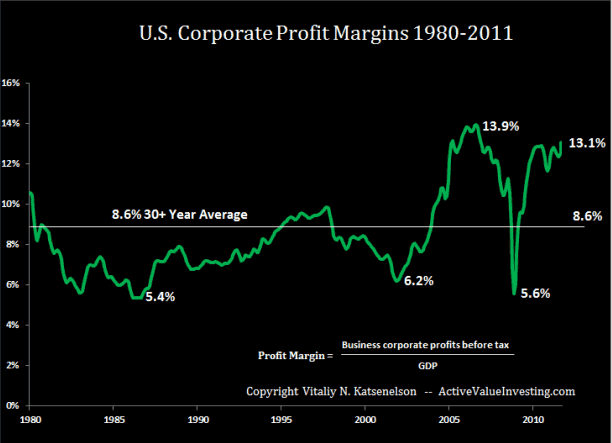
The second part is this: How long until the end of the sideways market? This is where it gets tricky. The market is only cheap today because profit margins are still high.  Corporate profit margins are about 50% above their average [see the chart below].  Once margins start normalizing (or, in this instance, decline), profits will either stagnate or fall.  So the market is not cheap.
Sideways markets end with lower P/Es, with one important point caveat: P/Es can stay at below-average levels for a while.  Right now, we are at average to slightly above-average P/E ratios, if you normalize earnings for current profit margins.  If you assume that we need to spend some time at below-average P/E levels, then we still have some pain ahead. We still have at least five or 10 years of sideways market left before we get to the below-average P/Es, and we could stay there for a while. So we are not there yet.
But the good news is that once sideways markets end, it is usually bull market time.
You are saying that unusually high profit margins are holding up valuations right now, and that eventually there will be a reversion to the mean. But can't profit margins stay at a high level for a long period of time, just as you said that P/E multiples can remain in a low range for a long period of time?  Can't this reversion to the mean occur over a protracted period?
Profit margins usually can’t hang in there as long as P/Es – just a few years. Because when one company starts making abnormal profits, competition comes in and erodes those profits.
Let me give you this example. Apple made terrific iPhone and iPads.  Several years later, there is now a lot of new competition that has introduced products that are almost as good, or products that are not as good but are much lower-priced (such as Kindle Fire).  And guess what? At some point, Apple, to be competitive, is going to have to lower its prices; and therefore its profit margins, which are at their highest level ever, will have to decline. 
The same thing applies for the economy as a whole, with some exceptions. There are some industries that can maintain high margins for a long period of time.  But for the economy overall, competition either forces lower prices or offers products or services that have more features for the same price, and in the end profit margins decline.
Why don't we turn to one of your stock selections. I saw you wrote recently that Microsoft is a company you like. It is also one of Seth Klarman’s holdings. How can it be that a stock as prominent as that, which is followed by as many analysts as it is, can offer the margin of safety that a value investor like you would require?
That’s what is interesting.  If I gave you Microsoft’s financial statements and I didn't tell you what company it was, you would say it was an incredible business. The company has more than doubled its earnings over the last five years and has a huge, cash-rich balance sheet, an enormous return-on-capital of nearly 40%, enormous cash-flow generation, and a near-monopoly in a lot of businesses where it operates.
Then you look at the stock price and you say, “Huh, this company hasn't gone anywhere for the last 12 years.”  Microsoft, to some degree, is a very typical sideways-market stock.  Its P/E was extremely high and its earnings were very high at the end of the last bull market, and its P/E collapsed. Its P/E was 50; and now, if you take out cash, it is at about 6.5 to 7 times earnings. There is a psychological element, where people look at the stock price and are fatigued by the nonperformance of the stock.
But there is another element that is very specific to Microsoft.  Even if you take the sideways market psychology into consideration, this company should not be trading at this valuation. Wall Street lost confidence in the company's management.  Microsoft’s business was so good that it was able to grow earnings on autopilot.
There is a lot more competition now, like Google and Apple. They are very strong financially. They're dominating their main markets.
The market is saying Microsoft is going to become a dinosaur. It's going to decline into obsolescence. This is where Klarman and I disagree with the consensus.
Look at Windows Vista; it was a horrible product. But it was still a financial success, because Microsoft had a monopoly. Then Windows 7 took over from Windows Vista and fixed it.  Windows 7 was not an innovative product, but it was a good solid product.
Then, a few months ago, Microsoft showed Windows 8, which is going to come out next year. This was the first time I looked at a Microsoft product and said “Wow!” It was created by a company that is paranoid about competition, not something that Microsoft ever was before.  It is a very good product that is going to work not only on PCs and laptops but also on tablets, which is very important, because tablets are the piece that Microsoft was missing.
Apple and Google were attacking Microsoft on the tablet front, and Microsoft did not have a product. Microsoft used to sell Windows for Netbooks, which were underpowered laptops. That category of products is gone. Microsoft is going to have a very solid product with which to compete against Apple and Google next year.
What are your thoughts on the new partnership between Microsoft and Nokia?
What I really like is that Microsoft did something uncharacteristic of itself. It did not go out and buy a company, but created an alliance with a company that was extremely desperate for an alliance – Nokia. Nokia was always great at making cell phones and hardware. But when the smart phones came around, Nokia could not come up with good operating-system software.
Then Nokia’s new CEO, who came from Microsoft, struck a deal by which Nokia is going to bet its future on Microsoft software.  All the smart phones that Nokia is going to make in the future will be based on Microsoft Windows.  Nokia came out with its first smart phone a few months ago in Europe, and it has received great reviews.
What is important about Nokia and Microsoft together is that to be successful in this market you have to have the marriage of hardware and software. That's why the companies are working together on developing software.
Microsoft says its Nokia alliance is going to be an accelerator. It is going to allow them to bring cellphones to the market very quickly. Nokia still has a very good brand name in Europe, and it has a tremendous distribution network.
Finally, you have a new trend that the media will be making a huge deal over the next three to six month: ultrabooks. They are thin, beautiful, powerful laptops. Basically, Intel did something brilliant; it trademarked the termultrabook. They are going to spend a couple hundred million dollars promoting the brand. If you are a PC-maker, and you want to make an ultrabook, it will have to meet very specific criteria that Intel has spelled out: It has to be light, have a solid-state drive, a fast boot time, and a long battery life. 
You are already seeing these ultrabooks hitting the stores, and we are going to see a lot more of them. Right now they are expensive, but the price will come down soon. They are going to make Windows products sexy again.
Now you have a company – Microsoft – that's actually doing smart things, and its stock price is incredibly cheap. It has a terrific balance sheet that is still based on a monopoly, for the most part. And you can buy it at one-third the multiple of the market.  It’s a no-brainer.
That's why Seth Klarman owns it, and we own it, too.
Vitaliy N. Katsenelson, CFA, is Chief Investment Officer at Investment Management Associates in Denver, Colo.  He is the author of The Little Book of Sideways Markets (Wiley, December 2010).  To receive Vitaliy’s future articles by email, click here or read his articles here.
Investment Management Associates Inc. is a value investing firm based in Denver, Colorado.  Its main focus is on growing and preserving wealth for private investors and institutions while adhering to a disciplined value investment process, as detailed in Vitaliy Katsenelson’s Active Value Investing (Wiley, 2007) book.